voyages labs🦉 Philosophy Club Türkçe
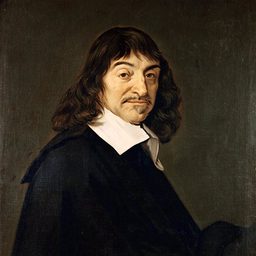
Descartes

Descartes

1596–1650 · thinker · 20 questions (easy 4 · medium 8 · hard 8)

René Descartes was a French philosopher and mathematician often called the founder of modern philosophy. In the Meditations (1641) he doubts everything in search of an unshakable foundation and finds it in “I think, therefore I am”. His split of mind and body into two separate substances shaped the debates of the next three centuries.

Take 10 questions on this topic →Quiz on all topics

Key ideas

Key concepts

cogito
“I think, therefore I am”: the first certainty that cannot be doubted.
evil demon
A hypothetical being who could deceive us about everything; a tool of radical doubt.
clear and distinct
For Descartes, the mark of ideas that can be known with certainty.
final causes
Explanation by purpose; Descartes removes it from natural science.
social contract
The theory grounding political authority in the consent of rational individuals.
state of nature
The imagined condition with no political authority.

Questions and explained answers

There are 20 questions on this topic; 10 examples with explanations are shown here. Take the quiz for all of them.

Easy

  1. What is the 'circularity' Reiman finds in Descartes's argument?
    1. The cogito assumes God exists
    2. The proof of God already relies on trusting reason, which it is meant to justify
    3. The evil demon proves itself
    4. Matter is defined by motion and motion by matter
    Show answer and explanation

    Correct answer: B) The proof of God already relies on trusting reason, which it is meant to justify

    God is supposed to guarantee that reason is trustworthy, but any argument for God uses reason. The lesson: no basis for trusting reason avoids presupposing that trust. Even doubting needs reasons, so doubt itself presupposes trust in reason.

    Source: Reiman, J. (1990). “Subjugation and the Natural Test of Morality.” In Justice and Modern Moral Philosophy, ch. 1. New Haven: Yale University Press. ↗

  2. What does Reiman see in Descartes's 'I am'?
    1. A proof that matter thinks
    2. The thinking subject taking the biblical name of God
    3. A return to Aristotle's essences
    4. A rejection of reason
    Show answer and explanation

    Correct answer: B) The thinking subject taking the biblical name of God

    Reiman links 'I am' to Exodus 3:13, where it is God's name. Giving it to the human thinker signals the end of the medieval worldview and prepares the claim that the thinker replaces God as ultimate authority.

    Source: Reiman, J. (1990). “Subjugation and the Natural Test of Morality.” In Justice and Modern Moral Philosophy, ch. 1. New Haven: Yale University Press. ↗

  3. According to Reiman, what did Descartes announce with “I think, therefore I am”?
    1. The demise of the medieval worldview and the birth of modernity
    2. A return to Thomistic philosophy
    3. The triumph of faith over reason
    4. The end of natural science
    Show answer and explanation

    Correct answer: A) The demise of the medieval worldview and the birth of modernity

    Reiman notes that Descartes took for the thinking subject the biblical name of God (“I am”) and so marked the end of the medieval worldview.

    Source: Reiman, J. (1990). “Subjugation and the Natural Test of Morality.” In Justice and Modern Moral Philosophy, ch. 1. New Haven: Yale University Press. ↗

  4. True or False: For Descartes, rational thought is an indifferent medium into which beliefs are simply received.
    1. True
    2. False
    Show answer and explanation

    Correct answer: B) False

    False. For Descartes thinking is a kind of testing, an examining of credentials in which only what is found worthy of belief is believed.

    Source: Reiman, J. (1990). “Subjugation and the Natural Test of Morality.” In Justice and Modern Moral Philosophy, ch. 1. New Haven: Yale University Press. ↗

Medium

  1. According to Reiman, Descartes replaced the dominant medieval attitude of ___ with ___.
    1. doubt → faith
    2. faith → doubt
    3. reason → experience
    4. purpose → faith
    Show answer and explanation

    Correct answer: B) faith → doubt

    For Descartes thinking is testing: a belief is accepted only after it overcomes doubt. So the thinker resists any authority until its credentials are checked, and his own reason becomes the highest authority.

    Source: Reiman, J. (1990). “Subjugation and the Natural Test of Morality.” In Justice and Modern Moral Philosophy, ch. 1. New Haven: Yale University Press. ↗

  2. According to Reiman, how does Descartes's rejection of 'final causes' undermine his own argument?
    1. It proves matter has purposes
    2. If God's purposes are impenetrable, He might have a good purpose for deceiving us
    3. It shows the cogito is false
    4. It restores medieval faith
    Show answer and explanation

    Correct answer: B) If God's purposes are impenetrable, He might have a good purpose for deceiving us

    Descartes says we cannot comprehend God's reasons, which he uses against appeals to purposes in science. But then God's goodness no longer rules out deception, so an impenetrable God is as great a threat to certainty as the evil demon.

    Source: Reiman, J. (1990). “Subjugation and the Natural Test of Morality.” In Justice and Modern Moral Philosophy, ch. 1. New Haven: Yale University Press. ↗

  3. Political authority not shown worthy of rational assent is indistinguishable from:
    1. Ignorance
    2. Oppression
    3. Faith
    4. The state of nature
    Show answer and explanation

    Correct answer: B) Oppression

    Reiman draws a parallel: unproved authority in knowledge is indistinguishable from ignorance, and unproved authority in politics from oppression.

    Source: Reiman, J. (1990). “Subjugation and the Natural Test of Morality.” In Justice and Modern Moral Philosophy, ch. 1. New Haven: Yale University Press. ↗

Hard

  1. Which is a consequence of Descartes's philosophy according to Reiman?
    1. Purposes are evicted from the physical world
    2. The human thinker replaces God as ultimate authority
    3. Knowledge based on faith in authority is indistinguishable from ignorance
    4. All of the above
    Show answer and explanation

    Correct answer: D) All of the above

    All three follow: the mechanistic view (matter in motion) removes built-in purposes; no authority binds a rational being unless proved valid to that being; and faith is doubt ignored, not doubt overcome.

    Source: Reiman, J. (1990). “Subjugation and the Natural Test of Morality.” In Justice and Modern Moral Philosophy, ch. 1. New Haven: Yale University Press. ↗

  2. In Reiman's reading, the 'state of nature' in social contract theory corresponds to:
    1. Cartesian doubt applied to politics
    2. An actual historical period
    3. The medieval worldview
    4. None of the above
    Show answer and explanation

    Correct answer: A) Cartesian doubt applied to politics

    Just as Descartes doubts all beliefs and rebuilds them, contractarians imagine political authority eliminated and ask whether rational people would agree to it. The contract is inscribed in the tendency of their reasoning, not an actual signing, so B is wrong.

    Source: Reiman, J. (1990). “Subjugation and the Natural Test of Morality.” In Justice and Modern Moral Philosophy, ch. 1. New Haven: Yale University Press. ↗

  3. Which claim about the social contract does Reiman make?
    1. It was actually signed at a point in history
    2. People normally see their political duties as self-imposed
    3. It rests on faith in authority
    4. None of the above
    Show answer and explanation

    Correct answer: D) None of the above

    All three are the opposite of the text. The contract is not an actual signing, people do not normally see their duties as self-imposed or agreed to, and the aim is to replace faith with proof to the thinking subject.

    Source: Reiman, J. (1990). “Subjugation and the Natural Test of Morality.” In Justice and Modern Moral Philosophy, ch. 1. New Haven: Yale University Press. ↗