voyages labs🦉 Philosophy Club Türkçe
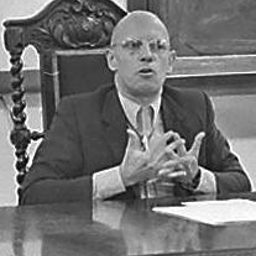
Foucault

Foucault

1926–1984 · thinker · 30 questions (easy 6 · medium 16 · hard 8)

Michel Foucault was a French thinker who applied Nietzsche’s genealogical method to institutions such as the prison, the clinic, the asylum and sexuality. In Discipline and Punish (1975) he shows that modern power works less by punishing than by observing and normalizing, and argues that power and knowledge are intertwined.

Take 10 questions on this topic →Quiz on all topics

Key ideas

Key concepts

power/knowledge
For Foucault: power and knowledge producing each other; the examination is an example.
archaeology
Studying a period’s discourses in terms of the rules beneath consciousness.
episteme
The underlying order that decides what can count as knowledge in an age.
disciplinary power
Power that shapes bodies through observation, normalizing judgment and the examination.
Panopticon
Bentham’s prison design in which inmates cannot tell when they are being watched.
docile bodies
Bodies made more useful and easier to control through discipline.
normalization
Classifying people as normal or abnormal and pushing them toward the norm.
biopower
Power that administers, regulates and optimizes the life of populations.
governmentality
“The conduct of conduct”: arts of governing from the state down to the self.
repressive hypothesis
The view that modern society merely represses sexuality; Foucault rejects it.
parrhesia
Frank, truthful speech at one’s own risk.
care of the self
The ancient practice of shaping oneself; an “aesthetics of existence”.

Questions and explained answers

There are 30 questions on this topic; 10 examples with explanations are shown here. Take the quiz for all of them.

Easy

  1. Who designed the Panopticon, the prison model Foucault made famous?
    1. Jeremy Bentham
    2. John Stuart Mill
    3. Thomas Hobbes
    4. Adam Smith
    Show answer and explanation

    Correct answer: A) Jeremy Bentham

    Bentham, the utilitarian. For Foucault the Panopticon is the emblem of disciplinary power.

    Source: Oksala, J. (2003/2026). “Michel Foucault.” In E. N. Zalta & U. Nodelman (eds.), Stanford Encyclopedia of Philosophy. First published 2 April 2003; substantive revision 21 April 2026. ↗

  2. In which year was Discipline and Punish published?
    1. 1961
    2. 1966
    3. 1975
    4. 1984
    Show answer and explanation

    Correct answer: C) 1975

    1975. 1961 is History of Madness, 1966 The Order of Things, 1984 volumes 2 and 3 of the History of Sexuality.

    Source: Oksala, J. (2003/2026). “Michel Foucault.” In E. N. Zalta & U. Nodelman (eds.), Stanford Encyclopedia of Philosophy. First published 2 April 2003; substantive revision 21 April 2026. ↗

  3. From which philosopher does Foucault take the name and idea of “genealogy”?
    1. Kant
    2. Hegel
    3. Nietzsche
    4. Descartes
    Show answer and explanation

    Correct answer: C) Nietzsche

    From Nietzsche’s On the Genealogy of Morality. Foucault applies it to concrete institutions such as prisons and clinics.

    Source: Oksala, J. (2003/2026). “Michel Foucault.” In E. N. Zalta & U. Nodelman (eds.), Stanford Encyclopedia of Philosophy. First published 2 April 2003; substantive revision 21 April 2026. ↗

  4. Which book grew out of Foucault’s doctoral thesis, sponsored by Georges Canguilhem?
    1. History of Madness (1961)
    2. The Archaeology of Knowledge (1969)
    3. Discipline and Punish (1975)
    4. The Care of the Self (1984)
    Show answer and explanation

    Correct answer: A) History of Madness (1961)

    History of Madness traces how reason separated itself from madness in the classical age, for instance through confinement.

    Source: Oksala, J. (2003/2026). “Michel Foucault.” In E. N. Zalta & U. Nodelman (eds.), Stanford Encyclopedia of Philosophy. First published 2 April 2003; substantive revision 21 April 2026. ↗

Medium

  1. Why does the Panopticon work even when no guard is watching?
    1. Prisoners are chained
    2. Cells are too small to move
    3. Inmates cannot tell when they are watched, so they regulate themselves
    4. Guards punish publicly every day
    Show answer and explanation

    Correct answer: C) Inmates cannot tell when they are watched, so they regulate themselves

    Visibility is a trap: the possibility of being seen is enough. Surveillance is internalized and power works almost automatically.

    Source: Oksala, J. (2003/2026). “Michel Foucault.” In E. N. Zalta & U. Nodelman (eds.), Stanford Encyclopedia of Philosophy. First published 2 April 2003; substantive revision 21 April 2026. ↗

  2. Which is NOT one of the three core techniques of disciplinary power?
    1. Hierarchical observation
    2. Normalizing judgment
    3. The examination
    4. Public execution as a spectacle
    Show answer and explanation

    Correct answer: D) Public execution as a spectacle

    Public execution belongs to the older sovereign power that Discipline and Punish opens with. Discipline works through the other three.

    Source: Oksala, J. (2003/2026). “Michel Foucault.” In E. N. Zalta & U. Nodelman (eds.), Stanford Encyclopedia of Philosophy. First published 2 April 2003; substantive revision 21 April 2026. ↗

  3. What are “docile bodies”?
    1. Bodies weakened by illness
    2. Bodies trained by discipline to be more useful and easier to control
    3. Bodies of prisoners after execution
    4. Bodies freed from all rules
    Show answer and explanation

    Correct answer: B) Bodies trained by discipline to be more useful and easier to control

    Schools, armies, factories and prisons drill bodies through timetables, exercises and observation, increasing their utility and their obedience at once.

    Source: Oksala, J. (2003/2026). “Michel Foucault.” In E. N. Zalta & U. Nodelman (eds.), Stanford Encyclopedia of Philosophy. First published 2 April 2003; substantive revision 21 April 2026. ↗

Hard

  1. Foucault defines governmentality as:
    1. The study of parliamentary procedure
    2. The conduct of conduct
    3. The abolition of the state
    4. The rule of the majority
    Show answer and explanation

    Correct answer: B) The conduct of conduct

    Governing means guiding how people conduct themselves, from state policy down to self-government. He develops this in the 1977–78 and 1978–79 lectures.

    Source: Oksala, J. (2003/2026). “Michel Foucault.” In E. N. Zalta & U. Nodelman (eds.), Stanford Encyclopedia of Philosophy. First published 2 April 2003; substantive revision 21 April 2026. ↗

  2. How does Foucault reverse Kant’s critical question?
    1. He asks what in the apparently necessary might be contingent
    2. He asks what in the contingent is necessary
    3. He rejects all historical inquiry
    4. He proves the existence of God
    Show answer and explanation

    Correct answer: A) He asks what in the apparently necessary might be contingent

    Kant looked for necessary conditions of knowledge; Foucault’s historical critique shows that limits presented as necessary have a history and could be otherwise.

    Source: Oksala, J. (2003/2026). “Michel Foucault.” In E. N. Zalta & U. Nodelman (eds.), Stanford Encyclopedia of Philosophy. First published 2 April 2003; substantive revision 21 April 2026. ↗

  3. What does genealogy, following Nietzsche, refuse to search for?
    1. Documents
    2. A pure, timeless origin (Ursprung) of things
    3. Power relations
    4. Historical details
    Show answer and explanation

    Correct answer: B) A pure, timeless origin (Ursprung) of things

    Instead of a noble origin, genealogy finds accidents, conflicts and reversals behind values and institutions.

    Source: Oksala, J. (2003/2026). “Michel Foucault.” In E. N. Zalta & U. Nodelman (eds.), Stanford Encyclopedia of Philosophy. First published 2 April 2003; substantive revision 21 April 2026. ↗