voyages labs🦉 Philosophy Club Türkçe
Kant

Kant

1724–1804 · thinker · 37 questions (easy 17 · medium 8 · hard 12)

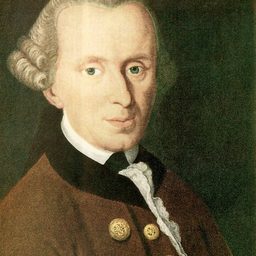
Immanuel Kant was a German philosopher who lived in Königsberg. In the Critique of Pure Reason (1781) he proposes a “Copernican revolution” in philosophy: objects conform to the forms of our knowledge, not the other way round. In ethics he developed the categorical imperative, which asks us to act only on principles that could hold for everyone.

Take 10 questions on this topic →Quiz on all topics

Key ideas

Key concepts

transcendental apperception
The unity of consciousness that ties all representations to one “I think”.
categories
Pure concepts of the understanding not drawn from experience (causality, unity…).
synthetic a priori
A truth known independently of experience that still adds to our knowledge.
a priori
Known independently of experience.
a posteriori
Known through experience.
phenomena
The world as it appears to us; knowable.
noumena
The unknowable world of things in themselves.
thing-in-itself
A thing as it is apart from our experience; unknowable for Kant.
Copernican revolution
The thesis that objects conform to our knowledge, not the reverse.
transcendental idealism
Kant’s view: the known world is shaped by the mind’s conditions, yet things in themselves exist.
manifold of intuition
The scattered, not yet unified data of the senses.
synthesis
The rule-governed combining of representations.
dogmatism
The assumption that reason can know reality beyond experience.
immanence
Knowledge being limited to possible experience.
transcendence
The claim that knowledge can reach beyond experience.
ontological proof
A proof of God’s existence from the concept of God alone (Anselm).
cosmological argument
A proof that reasons from chains of causes to a first cause, God (Aquinas).
real predicate
A predicate that adds content to a concept; for Kant “being” is not one.
categorical imperative
Kant’s unconditional moral law: act on maxims that could be universal laws.

Questions and explained answers

There are 37 questions on this topic; 10 examples with explanations are shown here. Take the quiz for all of them.

Easy

  1. What is the core claim of Kant's Copernican revolution?
    1. Knowledge must conform to objects
    2. Objects must conform to our knowledge
    3. All knowledge comes from sensation alone
    4. God guarantees that ideas match the world
    Show answer and explanation

    Correct answer: B) Objects must conform to our knowledge

    Kant reverses the traditional assumption: we know a priori only what we ourselves put into things. A is the old view he rejects; C is empiricism; D is Descartes/Augustine.

    Source: Bonevac, D. (1993). “Kant’s Copernican Revolution.” In R. C. Solomon & K. M. Higgins (eds.), The Age of German Idealism (Routledge History of Philosophy, Vol. VI), ch. 2. London: Routledge. ↗

  2. Kant's critical philosophy combines which two theses?
    1. Immanence (from skepticism) + rationalism (from dogmatism)
    2. Transcendence + empiricism
    3. Subjectivism + transcendence
    4. Empiricism + immanence
    Show answer and explanation

    Correct answer: A) Immanence (from skepticism) + rationalism (from dogmatism)

    Kant agrees with the skeptic that knowledge is limited to experience (immanence) and with the dogmatist that a priori knowledge is possible (rationalism). D is simply skepticism itself; B and C include transcendence, which Kant denies.

    Source: Bonevac, D. (1993). “Kant’s Copernican Revolution.” In R. C. Solomon & K. M. Higgins (eds.), The Age of German Idealism (Routledge History of Philosophy, Vol. VI), ch. 2. London: Routledge. ↗

  3. Where do Hume and Kant locate the source of necessity?
    1. Both: in the objects themselves
    2. Hume: feeling of expectation; Kant: unity of consciousness
    3. Hume: God; Kant: habit
    4. Hume: the categories; Kant: sensation
    Show answer and explanation

    Correct answer: B) Hume: feeling of expectation; Kant: unity of consciousness

    Both agree necessity is not found in experience and must come from us. Hume traces it to our passionate nature (expectation, habit); Kant traces it to the transcendental unity of apperception, which grounds the unity of objects.

    Source: Bonevac, D. (1993). “Kant’s Copernican Revolution.” In R. C. Solomon & K. M. Higgins (eds.), The Age of German Idealism (Routledge History of Philosophy, Vol. VI), ch. 2. London: Routledge. ↗

  4. What does "being is not a real predicate" mean?
    1. Nothing really exists
    2. 'God exists' is analytic
    3. Existence adds no content to a concept; it relates the concept to experience
    4. Existence is the most perfect property
    Show answer and explanation

    Correct answer: C) Existence adds no content to a concept; it relates the concept to experience

    The concept of a dollar and of an existing dollar have the same content. Saying something exists asserts a relation to the understanding and possible experience, so existence cannot be derived from a definition. Kant holds all existential judgments are synthetic, so B is false; D is Anselm's assumption.

    Source: Bonevac, D. (1993). “Kant’s Copernican Revolution.” In R. C. Solomon & K. M. Higgins (eds.), The Age of German Idealism (Routledge History of Philosophy, Vol. VI), ch. 2. London: Routledge. ↗

Medium

  1. Why does Descartes's evil deceiver go further than traditional skeptical arguments?
    1. It doubts only the senses
    2. It makes even logic and mathematics doubtful
    3. It proves that God does not exist
    4. It denies that we think
    Show answer and explanation

    Correct answer: B) It makes even logic and mathematics doubtful

    Sextus and Cicero challenged sensible knowledge. A deceiver who systematically misaligns mind and reality threatens a priori knowledge too, and so challenges Augustine's illumination.

    Source: Bonevac, D. (1993). “Kant’s Copernican Revolution.” In R. C. Solomon & K. M. Higgins (eds.), The Age of German Idealism (Routledge History of Philosophy, Vol. VI), ch. 2. London: Routledge. ↗

  2. If thought constitutes objects, why is the result not 'thinking making it so'?
    1. Because God checks our thoughts
    2. Because constitution follows the categories in a rule-governed way
    3. Because objects cause our thoughts
    4. Because imagination is always reliable
    Show answer and explanation

    Correct answer: B) Because constitution follows the categories in a rule-governed way

    The rules make knowledge possible, and a priori knowledge too, since we can discover the rules by which we constitute objects. Free combination (a golden mountain) yields no knowledge.

    Source: Bonevac, D. (1993). “Kant’s Copernican Revolution.” In R. C. Solomon & K. M. Higgins (eds.), The Age of German Idealism (Routledge History of Philosophy, Vol. VI), ch. 2. London: Routledge. ↗

  3. Why is 'rational psychology' (a theory of the soul from the 'I think') impossible?
    1. Because the 'I' does not accompany our thoughts
    2. Because representing the 'I' as a simple substance does not show it is one
    3. Because the soul is known only by the senses
    4. Because Hume proved the self is a substance
    Show answer and explanation

    Correct answer: B) Because representing the 'I' as a simple substance does not show it is one

    Moving from the representation to the thing is a fallacy and reopens the skeptic's objection. The transcendental 'I' is 'completely empty', a bare consciousness accompanying all concepts.

    Source: Bonevac, D. (1993). “Kant’s Copernican Revolution.” In R. C. Solomon & K. M. Higgins (eds.), The Age of German Idealism (Routledge History of Philosophy, Vol. VI), ch. 2. London: Routledge. ↗

Hard

  1. According to Kant, which is a component of dogmatism?
    1. Realism
    2. Transcendence
    3. Rationalism
    4. All of the above
    Show answer and explanation

    Correct answer: D) All of the above

    Dogmatism (Descartes, Leibniz) combines all three: thought can discover objective reality (realism), knowledge can extend beyond experience (transcendence), and there are innate concepts and synthetic a priori truths (rationalism).

    Source: Bonevac, D. (1993). “Kant’s Copernican Revolution.” In R. C. Solomon & K. M. Higgins (eds.), The Age of German Idealism (Routledge History of Philosophy, Vol. VI), ch. 2. London: Routledge. ↗

  2. Which is NOT one of the three syntheses in the subjective deduction?
    1. Apprehension in intuition
    2. Reproduction in imagination
    3. Recognition in a concept
    4. Illumination by the divine mind
    Show answer and explanation

    Correct answer: D) Illumination by the divine mind

    Illumination is Augustine's solution to Plato's problem, not part of Kant's model. Kant's three acts: binding sense data into single sensations, relating sensations as of the same object, and uniting them under a concept (a rule).

    Source: Bonevac, D. (1993). “Kant’s Copernican Revolution.” In R. C. Solomon & K. M. Higgins (eds.), The Age of German Idealism (Routledge History of Philosophy, Vol. VI), ch. 2. London: Routledge. ↗

  3. According to Kant, which of these can we have real knowledge of?
    1. The soul as a simple substance
    2. Things-in-themselves
    3. God's existence via a first cause
    4. None of the above
    Show answer and explanation

    Correct answer: D) None of the above

    All three go beyond possible experience. The 'I' is an empty accompanying consciousness, not a known substance; the categories apply only to objects we synthesize from sense data; causality has no meaning outside the sensible world.

    Source: Bonevac, D. (1993). “Kant’s Copernican Revolution.” In R. C. Solomon & K. M. Higgins (eds.), The Age of German Idealism (Routledge History of Philosophy, Vol. VI), ch. 2. London: Routledge. ↗