voyages labs🦉 Philosophy Club Türkçe
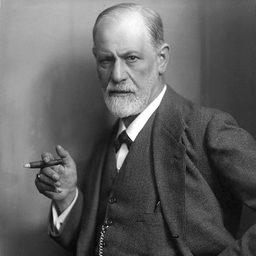
Freud

Freud

1856–1939 · thinker · 58 questions (easy 13 · medium 31 · hard 14)

Sigmund Freud was the Austrian neurologist who founded psychoanalysis. In The Interpretation of Dreams (1899/1900) he treats dreams as the “royal road” to the unconscious. His concepts of repression, id–ego–superego and transference reached far beyond psychology into literature, art and philosophy.

Take 10 questions on this topic →Quiz on all topics

Key ideas

Key concepts

unconscious
The realm of repressed drives and ideas hidden from direct view.
preconscious
Contents not conscious now but recallable.
super-ego
Heir of the Oedipus complex; conscience and source of guilt.
the id
The unorganized cauldron of drives ruled by the pleasure principle.
ego
The structure mediating between id, external world and super-ego.
Oedipus complex
The child’s wishful phantasies toward its parents.
libido
The energy of the sexual drives.
repression
Keeping unacceptable contents away from consciousness.
sublimation
Diverting drive energy into cultural and creative activity.
pleasure principle
The mental apparatus’s tendency to seek pleasure and avoid unpleasure.
death drive
The tendency of the living to return to an inorganic state.
Eros
The drive that preserves and binds life together.
seduction theory
The early theory tracing neurosis to real childhood seductions.
topographical model
The model of mind as Conscious, Preconscious and Unconscious.
structural model
The model of mind as id, ego and super-ego (1923).
narcissism
Libido directed toward oneself.
parapraxes
Slips and forgettings that betray the unconscious.
psychical reality
Inner reality in which phantasy acts as strongly as material fact.
affect
The felt quality of emotion; for Henry it cannot be unconscious.
anxiety
For Henry, the feeling of being unable to escape oneself.
constancy principle
The tendency to keep excitation at the lowest level.
ontic
The level of particular beings and contents.
ontological
The level of being or appearing as such.
ek-stasis
For Henry, appearing outside, as an object.

Questions and explained answers

There are 58 questions on this topic; 10 examples with explanations are shown here. Take the quiz for all of them.

Easy

  1. What is the key idea of the first phase of psychoanalysis (1886–1897)?
    1. The Oedipus complex
    2. The structural model of id, ego and super-ego
    3. The death drive
    4. The seduction theory: patients were victims of real, repressed childhood seductions
    Show answer and explanation

    Correct answer: D) The seduction theory: patients were victims of real, repressed childhood seductions

    In this phase Freud stressed the effects of the real world on people: patients had been affected by reality. He abandoned the theory privately in 1897 and publicly in 1905, later calling it his “first great error”.

    Source: Isbister, J. N. (1985). Freud: An Introduction to His Life and Work, ch. “The Psychoanalytic Movement”. Cambridge: Polity Press. ↗

  2. Freud’s topographical model divides the mind into:
    1. Id, ego and super-ego
    2. Body, soul and spirit
    3. The Conscious, the Preconscious and the Unconscious, related spatially but not anatomically
    4. Sensation, perception and understanding
    Show answer and explanation

    Correct answer: C) The Conscious, the Preconscious and the Unconscious, related spatially but not anatomically

    Freud said the spatial terms do not imply any connection with the brain’s anatomy; they belong to a “speculative superstructure” that can be abandoned if proved inadequate. Id, ego and super-ego belong to the later structural model.

    Source: Isbister, J. N. (1985). Freud: An Introduction to His Life and Work, ch. “The Psychoanalytic Movement”. Cambridge: Polity Press. ↗

  3. What characterizes the contents of the system Preconscious?
    1. They are unconscious but can be recalled if required
    2. They are always conscious
    3. They can never be recalled
    4. They belong to the external world
    Show answer and explanation

    Correct answer: A) They are unconscious but can be recalled if required

    In Isbister’s diagram, the Conscious contains what is conscious, the Preconscious holds contents that are unconscious but can be recalled, and the Unconscious holds contents that normally cannot be recalled.

    Source: Isbister, J. N. (1985). Freud: An Introduction to His Life and Work, ch. “The Psychoanalytic Movement”. Cambridge: Polity Press. ↗

  4. True or False: Freud presented the topographical model as a map of the actual anatomy of the brain.
    1. True
    2. False
    Show answer and explanation

    Correct answer: B) False

    False. Freud explicitly said the agencies are pictured in spatial terms “without, however, implying any connection with the actual anatomy of the brain”, and he admitted his analogies were “crude” and “incorrect” though instructive.

    Source: Isbister, J. N. (1985). Freud: An Introduction to His Life and Work, ch. “The Psychoanalytic Movement”. Cambridge: Polity Press. ↗

Medium

  1. How did Freud see the relation between psychoanalysis, observation and theory?
    1. Psychoanalysis is a natural science arising from observation; theories are the replaceable top, not the foundation
    2. Psychoanalysis is speculative philosophy
    3. Psychoanalysis is a religion of the soul
    4. Psychoanalysis is an art of interpretation without method
    Show answer and explanation

    Correct answer: A) Psychoanalysis is a natural science arising from observation; theories are the replaceable top, not the foundation

    Freud called it “an impartial instrument like the infinitesimal calculus” and asked “what else could it be?” than a natural science. In 1914 he wrote that ideas are not the foundation of science; observation alone is.

    Source: Isbister, J. N. (1985). Freud: An Introduction to His Life and Work, ch. “The Psychoanalytic Movement”. Cambridge: Polity Press. ↗

  2. What do Jung’s remark (the voice in the wilderness must sound scientific) and Ellul’s “new demons” suggest about Freud?
    1. Freud was hostile to science
    2. Freud’s appeal to science had a quasi-religious character; he was under the sway of the “new demons” of sex and an idolatrous idea of science
    3. Freud rejected sexuality as an explanation
    4. Freud was a Christian sociologist
    Show answer and explanation

    Correct answer: B) Freud’s appeal to science had a quasi-religious character; he was under the sway of the “new demons” of sex and an idolatrous idea of science

    Ellul argues modern man is as religious as medieval man: science, the state, the individual and sex become new sacreds. Freud’s talk of fulfilling his destiny shows how seriously, almost religiously, he took his science.

    Source: Isbister, J. N. (1985). Freud: An Introduction to His Life and Work, ch. “The Psychoanalytic Movement”. Cambridge: Polity Press. ↗

  3. What did the young Freud criticize the social democrats for, and why is this ironic?
    1. For being too scientific; later he became unscientific
    2. For ignoring sexuality; later he ignored it too
    3. For turning their views into a dogma allowing “no discussion”; similar criticisms were later directed at his own system
    4. For being too individualistic; later he became a collectivist
    Show answer and explanation

    Correct answer: C) For turning their views into a dogma allowing “no discussion”; similar criticisms were later directed at his own system

    In an 1875 letter to Silberstein, Freud said their ideological system based on “speculative theories” is the worst proof of their convictions. Isbister notes these remarks closely resemble criticisms later made of psychoanalysis.

    Source: Isbister, J. N. (1985). Freud: An Introduction to His Life and Work, ch. “The Psychoanalytic Movement”. Cambridge: Polity Press. ↗

Hard

  1. Which of the following is one of the premises that did NOT change throughout Freud’s work?
    1. The seduction theory
    2. The topographical model
    3. The view that all drives are sexual
    4. A relatively constant mental apparatus, related to the brain yet described in psychological terms
    Show answer and explanation

    Correct answer: D) A relatively constant mental apparatus, related to the brain yet described in psychological terms

    Isbister lists stable premises: a mental apparatus described psychologically, a largely hidden unconscious, psychological determinism and a continuum between normal and abnormal. The other options all changed: seduction theory was abandoned, the topographical model was supplemented, and aggressive drives were added.

    Source: Isbister, J. N. (1985). Freud: An Introduction to His Life and Work, ch. “The Psychoanalytic Movement”. Cambridge: Polity Press. ↗

  2. Which concept did Freud NOT introduce while patching up the topographical model before 1923?
    1. A second censorship between the preconscious and the conscious
    2. Self-preservative “ego drives” to account for aggression
    3. Narcissism to account for the psychoses
    4. The collective unconscious
    Show answer and explanation

    Correct answer: D) The collective unconscious

    The collective unconscious is Jung’s concept. Freud first added incompatible elements to the old model rather than revising it, until in the 1920s he declared that “we land in endless obscurities” if we keep to the old forms of expression.

    Source: Isbister, J. N. (1985). Freud: An Introduction to His Life and Work, ch. “The Psychoanalytic Movement”. Cambridge: Polity Press. ↗

  3. According to Henry, what does Freud really mean when he says that dreams, slips and symptoms “have meaning”?
    1. They are intentional messages from the patient
    2. They are linguistic signs
    3. They are meaningless noise
    4. They are produced by an unconscious tendency, a relation of indication (like smoke and fire), not of meaning-giving intention
    Show answer and explanation

    Correct answer: D) They are produced by an unconscious tendency, a relation of indication (like smoke and fire), not of meaning-giving intention

    Henry uses Husserl’s distinction between indication and signification: it is purely metaphorical to say that hands “speak”. Read this way, “everything has meaning” opens a domain without intentionality or meaning, the domain of life.

    Source: Henry, M. (1993). The Genealogy of Psychoanalysis (trans. D. Brick), ch. 9 “Man’s Monkey: The Unconscious”. Stanford: Stanford University Press. ↗