voyages labs🦉 Philosophy Club Türkçe
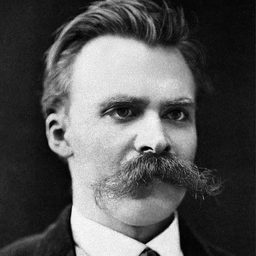
Nietzsche

Nietzsche

1844–1900 · thinker · 48 questions (easy 3 · medium 29 · hard 16)

Friedrich Nietzsche was a German philosopher who questioned values at their roots. In works such as Thus Spoke Zarathustra (1883–85) and On the Genealogy of Morality (1887) he discusses the “death of God”, the will to power, eternal recurrence and the revaluation of all values.

Take 10 questions on this topic →Quiz on all topics

Key ideas

Key concepts

will to power
The differential and genetic element of force, in obeying forces too.
eternal return
Not the return of the same but the repetition of difference.
active force
A form-giving, dominating force that goes to its limit.
reactive force
A dominated force working through adaptation and utility.
ressentiment
The weak’s pent-up resentment; a figure of reactive triumph.
bad conscience
Force turned inward against itself.
ascetic ideal
An ideal that preserves weak life by devaluing life.
nihilism
The will to nothingness; the devaluation of life.
genealogy
The art of interpreting the forces behind values.
Overman
The new, affirmative sensibility beyond reactive man.
transmutation
Putting affirmation in place of negation.
becoming-reactive
Active force becoming reactive when separated from its capacity.
pathos
Lived affect; how the will to power manifests itself.
affirmation
The quality of the will to power that joyfully affirms difference.

Questions and explained answers

There are 48 questions on this topic; 10 examples with explanations are shown here. Take the quiz for all of them.

Easy

  1. True or False: For Deleuze’s Nietzsche, we cannot use the outcome of a struggle to decide which forces are active; “the strong always have to be defended against the weak”.
    1. True
    2. False
    Show answer and explanation

    Correct answer: A) True

    True. Inferior forces can prevail without ceasing to be inferior in quantity and reactive in quality; it is even “the essence of fact” that the weak triumph. Measuring forces is therefore an art of interpretation, not abstract physics.

    Source: Deleuze, G. (1983). Nietzsche and Philosophy (trans. H. Tomlinson), ch. 2 “Active and Reactive”. London: Athlone Press / New York: Columbia University Press. ↗

  2. With which remark of Spinoza does Deleuze open the chapter?
    1. God is nature
    2. We do not even know what a body can do
    3. The mind is the idea of the body
    4. Freedom is understood necessity
    Show answer and explanation

    Correct answer: B) We do not even know what a body can do

    We chatter about consciousness and spirit but do not know what forces belong to a body. Nietzsche: “we are in the phase of modesty of consciousness”.

    Source: Deleuze, G. (1983). Nietzsche and Philosophy (trans. H. Tomlinson), ch. 2 “Active and Reactive”. London: Athlone Press / New York: Columbia University Press. ↗

  3. True or False: For Nietzsche, illness only diminishes us and can never give us a new power.
    1. True
    2. False
    Show answer and explanation

    Correct answer: B) False

    False. Illness separates me from what I can do, but it can also reveal a new capacity, a strange new power: “looking from the perspective of the sick toward healthier concepts and values”.

    Source: Deleuze, G. (1983). Nietzsche and Philosophy (trans. H. Tomlinson), ch. 2 “Active and Reactive”. London: Athlone Press / New York: Columbia University Press. ↗

Medium

  1. How does Nietzsche (as read by Deleuze) characterize consciousness?
    1. As self-consciousness, the master’s highest power
    2. As the foundation of all knowledge
    3. As a symptom: the reactive consciousness of a slave in relation to a master who is not himself conscious
    4. As a purely physical mechanism
    Show answer and explanation

    Correct answer: C) As a symptom: the reactive consciousness of a slave in relation to a master who is not himself conscious

    Consciousness is never self-consciousness but the consciousness of an ego in relation to a self that is not conscious. It appears when a whole wants to subordinate itself to a superior whole, which is why we do not know what a body can do.

    Source: Deleuze, G. (1983). Nietzsche and Philosophy (trans. H. Tomlinson), ch. 2 “Active and Reactive”. London: Athlone Press / New York: Columbia University Press. ↗

  2. What defines a body for Nietzsche?
    1. The relation between dominant and dominated forces; any two unequal forces in relation constitute a body
    2. A field or medium in which forces fight
    3. Consciousness and spirit
    4. A fixed biological substance
    Show answer and explanation

    Correct answer: A) The relation between dominant and dominated forces; any two unequal forces in relation constitute a body

    There is no “medium” or field of forces; reality is already quantity of force. A body can be chemical, biological, social or political. Its unity is a “unity of domination”, and it is always the fruit of chance.

    Source: Deleuze, G. (1983). Nietzsche and Philosophy (trans. H. Tomlinson), ch. 2 “Active and Reactive”. London: Athlone Press / New York: Columbia University Press. ↗

  3. According to Nietzsche, what is the real problem of the organism?
    1. Choosing between mechanism and vitalism
    2. Discovering the active forces without which reactions would not even be forces
    3. Measuring reactions more exactly
    4. Locating consciousness in the brain
    Show answer and explanation

    Correct answer: B) Discovering the active forces without which reactions would not even be forces

    Mechanism and vitalism interpret the same reactive forces in different ways, so the debate between them misses the point. Science follows consciousness and sees the organism “from the petty side”, the side of its reactions.

    Source: Deleuze, G. (1983). Nietzsche and Philosophy (trans. H. Tomlinson), ch. 2 “Active and Reactive”. London: Athlone Press / New York: Columbia University Press. ↗

  4. Why does Nietzsche criticize Darwin and admire Lamarck?
    1. Darwin interprets evolution in an entirely reactive way, while Lamarck foresaw an active plastic force of metamorphosis prior to adaptation
    2. Darwin was religious and Lamarck was not
    3. Lamarck used more mathematics
    4. Darwin denied struggle
    Show answer and explanation

    Correct answer: A) Darwin interprets evolution in an entirely reactive way, while Lamarck foresaw an active plastic force of metamorphosis prior to adaptation

    Nietzsche also says that if a struggle exists, its outcome is the reverse of what the Darwinians expect: “the defeat of the stronger”. Adaptation follows only after the spontaneous, form-giving forces.

    Source: Deleuze, G. (1983). Nietzsche and Philosophy (trans. H. Tomlinson), ch. 2 “Active and Reactive”. London: Athlone Press / New York: Columbia University Press. ↗

Hard

  1. What is the difference between forces, qualified as active or reactive according to their quantity, called?
    1. Dialectic
    2. Synthesis
    3. Entropy
    4. Hierarchy
    Show answer and explanation

    Correct answer: D) Hierarchy

    Forces that enter into relation have, together with their quantity, the quality corresponding to their difference in quantity. Active and reactive are the original qualities expressing the relation of force to force.

    Source: Deleuze, G. (1983). Nietzsche and Philosophy (trans. H. Tomlinson), ch. 2 “Active and Reactive”. London: Athlone Press / New York: Columbia University Press. ↗

  2. Which of the following is NOT a reactive function according to Deleuze?
    1. Memory and habit
    2. Nutrition and reproduction
    3. Adaptation and conservation
    4. Metamorphosis, the plastic power of giving new forms
    Show answer and explanation

    Correct answer: D) Metamorphosis, the plastic power of giving new forms

    Reactive forces fulfil the conditions of life: conservation, adaptation, utility; consciousness, memory and habit are reactive too. The power of transformation, the Dionysian power, is the primary definition of activity.

    Source: Deleuze, G. (1983). Nietzsche and Philosophy (trans. H. Tomlinson), ch. 2 “Active and Reactive”. London: Athlone Press / New York: Columbia University Press. ↗

  3. How does Deleuze resolve the apparent contradiction between Nietzsche’s praise of quantity and his critique of reducing quality to quantity?
    1. Nietzsche simply contradicts himself
    2. Quality is always superior to quantity
    3. Quantity is an illusion
    4. Difference in quantity is the essence of force; quality is the aspect of quantity that cannot be equalized
    Show answer and explanation

    Correct answer: D) Difference in quantity is the essence of force; quality is the aspect of quantity that cannot be equalized

    Nietzsche’s target is any determination that equalizes or cancels differences. He never defends quality against quantity as such; he defends difference in quantity against equality.

    Source: Deleuze, G. (1983). Nietzsche and Philosophy (trans. H. Tomlinson), ch. 2 “Active and Reactive”. London: Athlone Press / New York: Columbia University Press. ↗